
John 6
Today’s sermon title was Father’s House. Strangely enough, I did not even feel like going to church at first. I was resting, reading my Bible quietly, because in that moment I felt more at home simply being in the presence of God.
I opened to Gospel of John chapter 6, and what I encountered there felt deeply personal. The night before, I had spoken honestly to God about how tired I was — tired of laboring in my personal life, tired of striving, even tired in my walk with Him. Then I read the words of Jesus:
“Labour not for the meat which perisheth, but for that meat which endureth unto everlasting life.”
It felt as though God was answering me directly.
The Miracle Beyond Human Wages
John 6 begins with something symbolic. Jesus asks about bread for the multitude, and the response comes that even two hundred pennyworth of bread would not be sufficient to feed five thousand people. That amount represented wages — human effort, human earning, human limitation.
Yet somehow, in the middle of impossibility, a little boy appears with five loaves and two fishes.
What struck me was that Jesus never began with sufficiency. He began with surrender.
The miracle did not come from abundance. It came from what was willingly placed into His hands. Jesus took the bread, gave thanks, and multiplied it. Then afterward, He instructed the disciples to gather the fragments “that nothing be lost.”
That statement appears more than once in this chapter, and I do not believe it is accidental.
At first, it refers to bread. But later, Jesus reveals a deeper meaning:
“Of all which he hath given me I should lose nothing.”
The fragments become symbolic of people.
In many ways, we ourselves are like fragments gathered into Christ’s hands — remnants preserved by the Father so that nothing given to the Son will be lost. This is why the stories of the lost sheep, the lost coin, and the prodigal son matter so deeply. Heaven values what the world overlooks. God does not casually abandon what belongs to Him.
Even the twelve baskets remaining afterward seem prophetic — reflecting preservation, fullness, and the gathering of God’s people.
Laboring for Bread That Endures
One thing that became clear to me is that God does not measure provision according to human standards. We often focus on salaries, wages, and visible resources, but God looks beyond what we earn in order to reveal what only He can do.
And this is where many people struggle spiritually.
Jesus rebuked the crowd because they sought Him merely for temporary satisfaction. They wanted bread for the body, but He was speaking about bread for eternal life. He redirected their attention away from what perishes toward what endures forever.
Yet ironically, even within religious spaces, people are often taught to depend entirely on human labor and financial effort while being told to “have faith.” Sometimes we know how to collect wages, but we do not yet understand how God multiplies loaves and fishes.
Jesus was teaching something deeper:
there is a kind of labor that exhausts the soul because it only sustains temporary life, and there is another kind of pursuit that leads into eternal life.
“Thou Hast the Words of Eternal Life”
One of the most profound moments in the chapter comes when many disciples begin to leave because Jesus’ teachings offend them. Then Simon Peter responds:
“Lord, to whom shall we go? Thou hast the words of eternal life.”
Not merely life — but eternal life.
That distinction matters.
Jesus later says:
“The words that I speak unto you, they are spirit, and they are life.”
Words that carry the Spirit carry eternal life. Truth may offend people at times, but truth still leads toward life. Christ’s words are not temporary encouragements; they are eternal realities spoken into human existence.
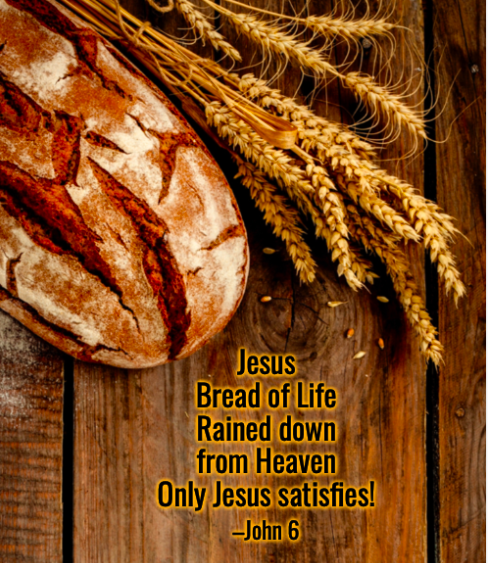
This is why John repeatedly emphasizes Jesus as the Bread of Life.
- John 6:35
- John 6:41
- John 6:48
The repetition is intentional.
Jesus was showing humanity that He Himself is the sustenance the soul truly needs. The Word became flesh, and eternal life took visible form.
The Bread from Heaven
The people listening to Jesus judged Him according to His earthly background. They asked:
“Is not this Jesus, the son of Joseph?”
They saw a carpenter’s son. They saw familiarity. They saw earthly identity.
But Jesus answered them with eternal truth:
“Your fathers did eat manna in the wilderness, and are dead.”
He repeated this idea several times throughout the chapter. The manna sustained physical life temporarily, but it could not conquer death. Christ, however, presented Himself as the true Bread from Heaven — the bread that gives everlasting life.
Again and again, Jesus emphasized belief:
- belief on Him,
- believing in the One sent by the Father,
- receiving eternal life through Him.
This repetition reveals the heart of the Father.
The Father’s Will and the Father’s House
As I continued reading, something else became clear to me: there is a distinction between the Father’s will and the work done in the Father’s house.
Jesus says:
“And this is the Father’s will which hath sent me, that of all which he hath given me I should lose nothing.”
Then He says:
“And this is the will of him that sent me, that every one which seeth the Son, and believeth on him, may have everlasting life.”
These statements reveal two connected dimensions of Christ’s mission.
First, as Shepherd, Jesus was entrusted with people whom He would preserve so that none would be lost.
Second, within the Father’s house, He calls people into belief so they may receive eternal life.
The work of ministry and the will of God are connected, but they are not always identical.
The work involves preaching, gathering, teaching, and serving.
The Father’s will reaches deeper:
that none be lost,
that hearts believe,
and that people are raised up on the last day.
This is why Jesus later says:
“And I, if I be lifted up from the earth, will draw all men unto me.”
Taught of God
Another verse that stood out deeply to me was when Jesus said:
“They shall all be taught of God.”
What a powerful statement.
Jesus explains that every person who truly hears and learns from the Father comes unto Him. In other words, salvation is not merely intellectual agreement — it is divine drawing.
No one comes unless the Father draws them.
This means that behind every genuine encounter with Christ is the invisible work of God Himself.
Flesh, Blood, and Shared Life
Jesus then speaks in even deeper spiritual language:
“My flesh is meat indeed, and my blood is drink indeed.”
His flesh becomes the bread.
His blood becomes the drink.
Through this imagery, Jesus reveals complete spiritual union and dependence upon Him.
Then He says:
“As the living Father hath sent me, and I live by the Father: so he that eateth me, even he shall live by me.”
This may be one of the most beautiful revelations in the entire chapter.
The Son lives by the Father.
And we live by the Son.
Life flows from the Father to Christ, and from Christ into us. We are not meant to exist independently from Him. We become extensions of the life we receive from Him.
Final Reflection
John 6 is ultimately not just a chapter about bread.
It is about preservation.
It is about eternal life.
It is about the Father gathering what belongs to Him.
It is about Christ becoming everything necessary for the soul.
The chapter begins with human insufficiency — wages that cannot feed the multitude — and ends with divine sufficiency found entirely in Christ.
And perhaps that is the lesson I needed most.
When human labor reaches its limit, heaven introduces another kind of bread.
The Bread of Life.