Revival can only happen when God hears our cry. If He turns His face from us—that’s a scary thought. But this people felt it, and Jesus felt it too. Sometimes, when everything fails, when nothing works at all, we feel that same desperation.
I was listening to “Hear My Cry”—by Fred Hammond (Inner Court), and also by the Motor City Mass Choir—and I completely understood Psalm 61.
For revival to happen, God has to hear our cry. Thank God Jesus intercedes for us—but that means one has to accept the truth of God’s Word; else it’s a waste of time. There’s a verse that says:
“If my people, who are called by my name, will humble themselves and pray, and turn from their wicked ways, then I will hear from heaven and heal their land.” (2 Chronicles 7:14)
It’s not just about crying; it’s about humbling ourselves, turning from sin, and accepting God’s truth. The cry is essential, but it must come from a heart that is willing to receive God, to change, to obey. Otherwise, it’s just noise.
Sometimes, when life fails and everything seems lost, Psalm 61 becomes more than words—it becomes a mirror of your soul, a song that says, “I see you. I hear you. You are not alone.” And that is where healing begins.
Sometimes I listen to certain comments from pastors and motivational speakers, and I’m honestly alarmed. I find myself thinking, “What if someone actually believes this?”
I’m not someone who claims to be an authority on love or relationships. Why? Because I tend to believe that what people talk about or emphasize the most often reflects what they lack—except when it comes to God. For example, if someone constantly talks about money, they may not have it. If someone keeps emphasizing respect, it might be because they feel they lack it. Scripture says, “Out of the abundance of the heart the mouth speaks,” and “where your treasure is, there your heart will be also.” That’s just my perspective.
I once heard a popular pastor say, “Never marry a woman who is not established—one who has done nothing for God or herself.” Immediately, my mind went to his own wife, who spent over 15 years as a housewife raising their children. In fact, as of 2024, she had only recently gone back to school—an institution run by the pastor’s own family.
I’ve also seen a well-known Nigerian banker, formerly Muslim, convert to Christianity and begin preaching and advising women. My point is this: a woman—especially within marriage—can become many things over time. That’s why the man, like Christ, is described as a builder.
So I’m not triggered by what was said, but I question it.
Then I heard a woman share that God made her wait two years before her “God-ordained spouse” came, and that she served in church during that time. In my mind, I thought: it was Jacob who served to obtain a wife (Genesis 29:20). So why are we now framing service to God as a pathway to marriage?
Whatever we do for God, and the sake of the gospel should be between us and God. We don’t serve God to secure outcomes like marriage—we serve Him to align with His will. I know people will say Ruth was working Boaz Vinyard, it’s a cultural thing again to marry within the Jewish family as custom, and why didn’t we say Queen Esther married a Jew. (Custom). You can serve or not serve in a church and still marry right according to Gods will. I even know many church people that do crazy things outside the church….no two story is the same, it’s as saying Adam met his wife in a church rather than in Eden (the presence of God) or Hannah met her husband in a church. Jacob met Racheal by a well why not in the tabernacle or temple.
Scripture says it is God’s will that we prosper and be in good health, even as our soul prospers (3 John 1:2). It also says the kingdom of God here on earth is his will which is righteousness, peace, and joy in the Holy Spirit (Romans 14:17). And we are instructed to give thanks in all circumstances as it’s his will (1 Thessalonians 5:18).
Marriage itself was created for a purpose—to reflect Christ and the Church. But it is not a universal mandate. Scripture clearly states that not everyone is called to marry (Matthew 19:10–12; 1 Corinthians 7:7–9).
So when people keep prescribing formulas for marriage, it becomes problematic. No two marriages are the same. People may share similar experiences, but their behaviors, identities, and even fingerprints are different. Each person has a unique identity in Christ, so you cannot model your marriage entirely after someone else’s.
It’s unrealistic—and sometimes misleading—for people to create rigid rules like: “Don’t marry a woman who isn’t established” or “avoid anyone with family baggage.” That’s not sound doctrine.
You can advise people on who to look out for in marriage but telling someone exactly who to marry goes beyond human authority. The only clear instruction Scripture gives is: “Do not be unequally yoked with unbelievers” (2 Corinthians 6:14). That’s why since Adam blaming God that it is the woman you gave to me, God never picked a spouse for man again.
Paul also writes that if someone cannot manage their own household, how can they care for God’s church? (1 Timothy 3:5). That places priority on personal responsibility before public ministry.
And regarding women, Scripture says: “Their wives likewise must be dignified, not slanderers, but sober-minded, faithful in all things” (1 Timothy 3:11). It does not say she must be “established,” physically perfect, or meet cultural standards of success.
So where are all these extra requirements coming from?
In all honesty, I don’t consider myself religious, and I’m cautious about what I’d call “churchianity.” The Church exists to serve Christ’s purpose: to win souls, encourage believers to remain in Him, comfort the broken, and care for the poor and widows—not to promote human standards or personal ideologies.
I was in church today, and instead of feeling relieved, I felt overwhelmed. The pastor was preaching about “dying to self for kingdom fruitfulness.” I understand that being a pastor isn’t easy, but one of the first things I noticed was how sparse the congregation was—many youths in key positions weren’t present. The pastor used this as part of his message.
He preached from John 12:24–25, saying that unless a grain of wheat falls to the ground and dies, it cannot be fruitful. He emphasized that we all desire spiritual power, higher positions, and financial breakthrough, but we are unwilling to “die to self.” While this is partially true—because dying to self-weakens the flesh and allows the inner man to grow—I believe it deals more with the unseen. Scripture says we reap what we sow in the spirit. (sow in the spirit reap in the spirit, sow in the flesh reap in the flesh) Galatians 6:8.
However, attaining higher positions or financial breakthroughs on earth also requires faith—not just “dying to self.” Dying to self is about conforming to the image of Christ, not necessarily about material success. This raises a question: why do unbelieving nations like Thailand prosper and experience financial breakthroughs without this concept of “dying to self”?
The pastor also said that dying to self is surrender—and I agree that we ought to prioritize God above everything. As Scripture says, “Seek ye first the kingdom of God, and all these things shall be added unto you.” In seeking God, other things—like a car, a spouse, or provision—may come, but not necessarily because we seek them. God may withhold certain things if we are not aligned with Him.
He spoke about the humiliation Jesus endured, describing Him as the most valuable grain of wheat that died for us. This is true—Jesus was sinless, defended the poor, healed the sick, and stood for justice, even confronting religious leaders.
He then referenced Philippians 2:5–10, encouraging us to have the same mindset as Christ. That is valid—we came to Christ because He is our root. However, I found an issue when he began to mix metaphors. He said that every “seed” has potential, and if it is not planted, it cannot grow. While that principle is true, Scripture (Luke 8:11) clearly states that the seed is the Word of God. Humans are not seeds; we are vessels that carry the seed.
He went on to say that fruitfulness begins when self-dies. While this aligns with the fruit of the Spirit, fruitfulness is spiritual and not necessarily visible. Then he shifted again, saying people do not serve in the house of God because of pride and a lack of dying to self.
That didn’t sit right with me.
When Jacob first encountered the house of God, he said, “This is a dreadful place… the Lord is in this place” (Genesis 28:16–17). The house of God is meant to carry His presence. The question is: what presence does the church carry today?
I once heard someone say that even if a school is bad, you don’t stop going—you change the school. That’s why many people avoid certain institutions when the quality of learning and character is low. The same logic applies to the church: you don’t just endure dysfunction—you fix it.
In 2 Chronicles 7:1, the glory of God filled the temple. Ephesians 5:2 speaks of Christ’s sacrifice as a fragrant offering. If the church lacks that fragrance of sacrifice and love, people will not be drawn to it.
The church is like a house. If your roof is leaking or your water system is broken, you don’t just stay and tolerate it—you fix it.
Fruits and seeds.
I’ve seen examples in my own family. One aunt served faithfully in church, yet her children have gone in completely different directions. Another, who was not as involved, relocated abroad and progressed significantly. This suggests that progress in life is not solely tied to church activity—it also involves faith, and even unbelievers exercise faith.
Scripture says, “Whosoever calls upon the name of the Lord shall be saved” (Romans 10:13). This applies broadly—even backsliders can call on God and experience deliverance in specific situations.
I also recall a friend who served as a drummer in church. When he lost his job and stopped attending, no one reached out. When he eventually returned, he was criticized instead of supported—and he left. Is that the aroma of Christ? Shouldn’t love come first, followed by correction?
Jesus said, “If I be lifted up, I will draw all men unto me.” If Christ’s love draws people, then the church—His body—should do the same. But if the church lacks love, it loses that drawing power.
The pastor said no one wants to die, yet everyone wants heaven. That’s true. But personally, I would “die to self” for my relationship with God—not necessarily for an institution. Christ is already the perfect sacrifice. If I could save myself by dying, I wouldn’t need Him.
Scripture says we should have the same mindset as Christ but not claim equality with Him. Humility comes from understanding that we serve because of love, not obligation.
So, if this is the message being preached, why should I serve there?
People once went to church because they believed God answered prayers. Now, many understand that faith plays a major role. If I go to church only for miracles, I am chasing manna—not the Bread of Life. And manna, as we saw in the time of Moses, perishes.
Ultimately, our will must align with God’s will. But the real question is: is the church, as the body of Christ, aligned with God’s will?
As Galatians 2:20 says: “I have been crucified with Christ; it is no longer I who live, but Christ lives in me.” So, I live for Christ not only for the church.
As Easter approaches, I know we will receive many messages, but I thank God that He raised His Son, and on the third day, He is perfected in us.
Luke 13 begins with Jesus addressing people who reported the Galileans to Him. He clarified that one does not have to be the worst of sinners to suffer judgment. He warns that unless we repent, we will all likewise perish, just as the Galileans did.
For me, the number 18 signifies judgment—a day when one is either acquitted or condemned. The number of times 18 appears in this passage is remarkable. Jesus highlights the 18 people upon whom the tower of Siloam fell. It is interesting that while the pool of Siloam brought healing, the tower of Siloam brought destruction. “Siloam” itself means “sent” or “sent forth.” Jesus emphasizes repentance twice in this context (Luke 13:3 and Luke 13:5), first referring to the Galileans and then to the 18 victims of Siloam.
Jesus then gives a parable about a vineyard, where the owner comes seeking fruit over a period of three years. In verse 11, we encounter a woman who had a spirit of infirmity for 18 years. This time, it was not about judgment unto doom; instead, she was loosed from her infirmity because she was a daughter of Abraham (Luke 13:16).
Jesus also speaks to the rulers in the synagogue about this woman, using the moment to illustrate what the kingdom of God is like—something that starts small but grows greatly, as seen in the examples of the mustard seed and the leaven.
He then urges us to strive to enter through the narrow gate. A strait is like a narrow passage, similar to what Moses experienced at the Red Sea (we even have our modern day Strait of Hormuz). The English dictionary describes a strait as “a situation characterized by a specified degree of trouble or difficulty”—truly, a time of Jacob’s trouble, perilous times indeed. Luke says that many will seek to enter and will not be able to. Jesus then explains why:
He says that once the master of the house rises and shuts the door, people will begin to knock, saying, “Lord, Lord, open to us.” But He will reply, “I do not know you.” Those knocking will try to justify themselves by pointing to their works. They will say, “We ate and drank in Your presence,” meaning they experienced God’s presence, and even taught in the streets. Yet Jesus will still reject them. Why? Because they worked iniquity—they were workers of iniquity.
As we await the coming of the Lord, we also look forward to the day when Jerusalem, the city that kills the prophets, will proclaim, “Baruch haba b’shem Adonai”—“Blessed is He who comes in the name of the Lord.”
Remember, Jesus also did works—He cast out demons, performed healings, and on the third day, He was perfected.
Happy Easter in advance. Luke 13:30 says, “And behold, there are last who will be first, and there are first who will be last.” May God help us all.
I was in a meeting at the office when I suddenly realized that Scripture is being fulfilled right before our eyes. I won’t go into details about what happened, but in that moment, I truly understood what the word “perilous” means.
Later, I checked my phone and saw someone praying for our leaders. Yet, I felt a sense of hopelessness about the state of the world. Around the same time, I heard someone I know—someone who prays, believes in Jesus, and is spiritually more mature than I am—say that nothing good comes to those who do good, especially to good women. That statement troubled me. First, there is none good but God.
So, I decided to pray for our leaders. As I turned to my devotional, I was led to Jeremiah 42.
In this passage, the people of Judah were in captivity. Even in that condition, God had promised to provide for them. However, they found themselves at a crossroads. They wanted to leave Babylon and go to Egypt, and knowing that Jeremiah was a true prophet, they came to him asking that he would show them the way they should go and what they should do.
Jeremiah agreed to pray to God on their behalf and promised to declare whatever the Lord revealed to him. In Jeremiah 42:6, the people—especially their leaders—assured Jeremiah that they would obey the voice of God, whether the message was favorable or not.
After ten days, Jeremiah returned with God’s answer: they were not to go to Egypt. Instead, they were to remain in Babylon, and God would preserve them and eventually restore them to their land (Jeremiah 42:11). Later, we understand why. In Jeremiah 43:12–13, God reveals His intention to bring judgment upon Egypt because of its idols and false gods.
However, despite this clear instruction, the people refused to obey. Jeremiah had warned them that if they chose to go to Egypt—seeking safety from war, hunger, and uncertainty—they would instead encounter the very things they were trying to escape sword, famine, and pestilence (Jeremiah 42:21–22).
Reflecting on this, I realized something profound: we often pray for our leaders, but do they truly obey the voice of God? And even more personally, when we seek God’s direction, do we actually follow it?
The Bible tells us in 2 Timothy 3:1 that in the last days, perilous times will come. We also see in Daniel 12:4 that “many shall run to and fro, and knowledge shall be increased.” Today, we witness people constantly moving, relocating, and sharing experiences across the world. With the rise of AI and technology, knowledge is indeed increasing at an unprecedented rate.
So, I am left wondering: where do we stand in this generation? Do we truly obey the voice of God—or do we only seek it when it suits us?
The Scripture here reveals that the revelation of Jesus Christ is for the things that will come to pass in the time at hand.
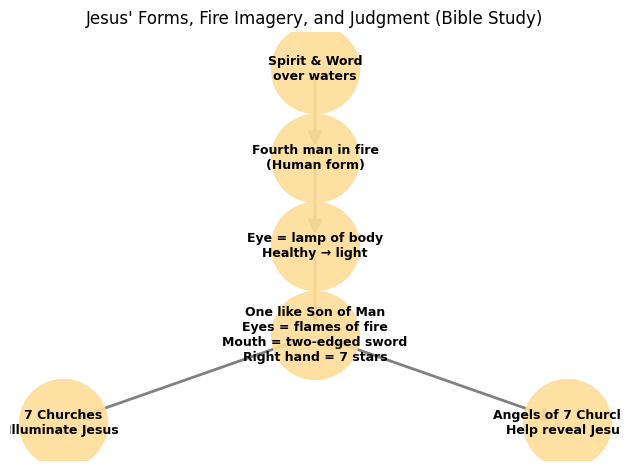
Jesus’ position as the firstborn of the dead and Prince of the kings of the earth is central. Jesus has many forms: as the Living Water (John 4:10–14), Word becoming flesh (John 1:14), Son of Man (Matthew 18:11; Daniel 7:13), and Bread of Life (John 6:35). Revelation 1:15 describes Jesus’ voice as “the sound of many waters,” which can be compared to Genesis 1:1–2, where God’s Spirit and Word hovered over the waters at creation. Revelation also identifies Him as the Alpha and Omega, highlighting His eternal position.
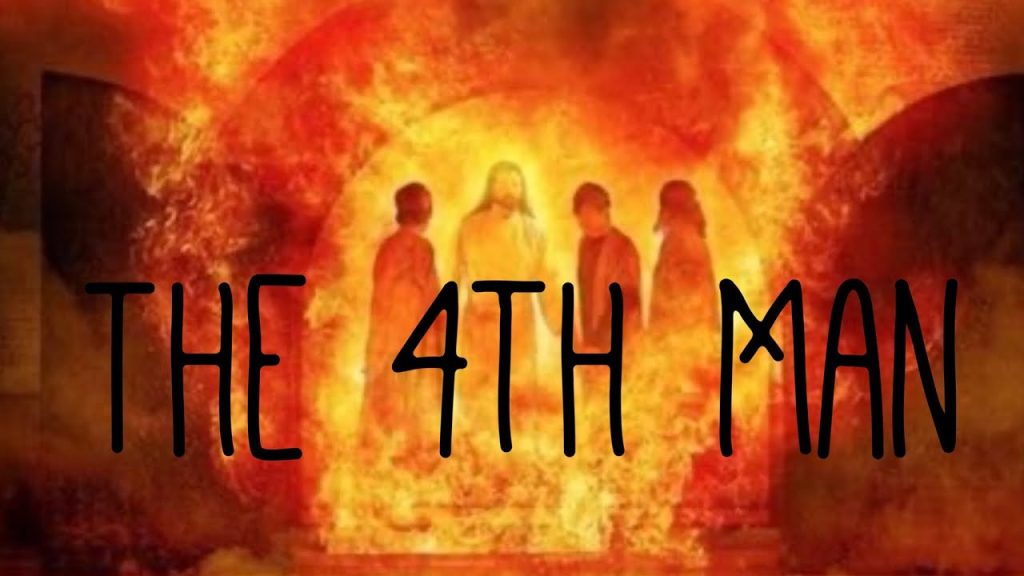
We ought to remember Christ’s position and standing with God when tribulation comes. This is exemplified in Daniel 3:25, where Jesus’ position and presence with Shadrach, Meshach, and Abednego in the fire is revealed. He was the fourth man in the fire during their trial and tribulation. Moreover, Revelation highlights how they overcame their trials—not by escaping danger, but by saying that even if God did not save them, they would not bow to the idols. They literally fought for the kingdom of God with patience, trusting in Him. Revelation presents this as the kingdom of Jesus Christ and the patience of Christ, through which they overcame. We may live under different kingdoms of this world, but the one kingdom to which we surrender is the kingdom of God.
Why, then, was the Son of Man seen in the midst of the seven candlesticks? What does it mean? Daniel 3:25 says:
“He answered and said, Lo, I see four men loose, walking in the midst of the fire, and they have no hurt; and the form of the fourth is like the Son of God.”
Here in Daniel, there is no detailed description of Jesus’ form, because He had not yet been fully revealed as both God and Man. Only a human form was revealed in the fire. In Revelation 1:14, His form is described in detail, with His eyes like a flame of fire. Fire usually signifies judgment (Isaiah 66:15–16; Revelation 20:15; Luke 3:17; Malachi 4:1) or a testing/trial (1 Corinthians 3:12–13; Zechariah 13:9; Job 23:10; Proverbs 17:3; Malachi 3:2–3).
We should also remember what Jesus said:
“The eye is the lamp of the body. If your eyes are healthy, your whole body will be full of light. But if your eyes are unhealthy, your whole body will be full of darkness. See to it, then, that the light within you is not darkness.” — Matthew 6:22–23
Revelation 1:14 tells us that His eyes were like a flame of fire, indicating judgment or trial. At this revelation, He was in the midst of the seven candlesticks (his position). Here, He is described as “one like the Son of Man”—revealed with a human form. His head, hair, feet, and garment are described because He had already appeared to humanity in a visible form. In contrast, in Daniel 3 His form was not described. Revelation 1:16 further describes His countenance.
Revelation 1:20 clarifies that the seven stars in Jesus’ right hand (Revelation 1:16) are the angels of the seven churches, and the candlesticks are the seven churches. The candlesticks symbolize Jesus’ illumination to the world, with the angels helping to reveal this to the churches. Notice in Revelation 1:16 that after describing His right hand holding the seven stars, it says that out of His mouth came a sharp two-edged sword (Hebrews 4:12).
The candlesticks represent the churches. Hence, this is a heavenly event in which Jesus’ form is like that of man, not His full divine nature.
So, while there’s a mystery about the 7 stars, he is still alive but was dead behold he is alive forevermore.
               ┌──────────────────────────────┐
               │       Creation & Word        │
               │ Genesis 1:1–2               │
               │ Spirit and Word over waters │
               └─────────────┬──────────────┘
                             │
                             ▼
               ┌──────────────────────────────┐
               │    Daniel 3:25 – Trial      │
               │  Jesus as 4th Man in Fire   │
               │  Human form revealed        │
               │  Protection of faithful     │
               └─────────────┬──────────────┘
                             │
                             ▼
               ┌──────────────────────────────┐
               │ Matthew 6:22–23              │
               │ Eye = lamp of body           │
               │ Healthy eye → full of light │
               │ Unhealthy eye → darkness     │
               └─────────────┬──────────────┘
                             │
                             ▼
               ┌──────────────────────────────┐
               │ Revelation 1:14–16           │
               │ “One like the Son of Man”    │
               │ Eyes = flames of fire        │
               │ Head, hair, feet, garment    │
               │ Right hand holds 7 stars     │
               │ Mouth = sharp two-edged sword│
               └─────────────┬──────────────┘
                             │
    ┌────────────────────────┴─────────────────────────┐
    ▼                                                  ▼
┌───────────────────────┐ ┌───────────────────────┐ │ Seven Candlesticks │ │ Seven Stars │ │ = 7 Churches │ │ = Angels of 7 churches│ │ Illuminate Jesus to │ │ Help reveal Jesus │ │ the world │ │ │ └───────────────────────┘ └───────────────────────┘
Most people fail to realize that Ezekiel 3 and Ezekiel 18 is the cumulation of what’s in Ezekiel 33. What more it goes into great detail into explaining how idolatry, covetousness, and warning all play a grand plan in warning Gods people of what is to come if they will heed.
In biblical typology, the “sword” during the time of Ezekiel often represented the judgment of God upon a nation. In the New Testament, however, the sword is frequently used to represent the word of God (see Epistle to the Hebrews 4:12 and Epistle to the Ephesians 6:17). In a literal sense, of course, a sword is simply a weapon.
In Ezekiel’s day, he received a message from the Lord and was commanded to warn the people. If he failed to deliver the warning, the blood of those people would be required of him (see Book of Ezekiel 33:6).
Book of Ezekiel 33:4 says that if anyone hears the sound of the trumpet and does not take warning, and the sword comes and takes him away, his blood will be on his own head.
As we approach days marked by wars and rumors of wars, as spoken of by Jesus Christ in Gospel of Matthew 24:6, He instructs us to be watchful and prayerful (see Gospel of Matthew 26:41). These scriptures feel especially relevant, because ultimately it is God who allows wars and who brings them to an end (see Book of Psalms 46:9). It is almost as though humanity is waiting for the sound of a trumpet—whether from heaven or from the alarm of war. One thing remains certain: the ways of the Lord, Yahweh, are just.
Book of Ezekiel 33:11–17 continues by showing how Yahweh’s ways are judged by people. The Lord declares that He takes no pleasure in the death of the wicked, but rather that they turn from their evil ways and live. In truth, every one of us carries some measure of wickedness within; therefore, God calls all people to repent and turn from evil.
However, if someone believes he is righteous and trusts in his own righteousness, yet later commits iniquity, none of his previous righteousness will be remembered; he will die because of his sin (see Book of Ezekiel 33:13).
This serves as a stark reminder that human righteousness, by itself, is like filthy rags before God (see Book of Isaiah 64:6). Therefore, as we go about our daily lives, we must continually remove idolatry and covetousness from our hearts, seeking instead to lay hold of what God has prepared for us (see Book of Ezekiel 33:25, 31–33).
For many of us, perhaps it is time to watch and pray.
I remember when I was like 12 or 13, someone I know was going through a heartbreak, and the first words she told me were that she had plenty of questions for God to answer in heaven. Very daring, I must tell you. I am much older now and realize the futility of such a statement. As Job would say, who can question the Almighty God, the one who holds all wisdom? But she was going through pain—some shape us, and others break us, if we heed God’s word or not. Some even say the things that give us the hardest time are those that are like us. And we are in God’s image, yet we give Him the hardest time. He didn’t tell us to get into certain relationships, yet we blame Him. It’s even the same with colonies—the ones that give us the hardest time are the ones we colonize, the ones that have speech like us and sound like us, and we blame them too. Even as Adam blamed God, humans never change; we just recycle madness in our hearts.
Sometimes, when we go through afflictions, pain, and suffering, we forget what the goodness of God looks like. David said, “I had fainted except I had seen the goodness of God.” Psalm 27:13 Even if any man comes to tell you of the goodness of God (didn’t God give you this and that, as with Job) in your hour of misery, except it’s the voice of the Spirit, you will probably answer as Job answered. Job said, “I speak out of the bitterness of my mouth.” No words will bring satisfaction to your heart; in fact, any goodness shown to you at that point will feel like a rub of salt that slowly fades until we hear from God.
I always say: never comfort a man with mere words during affliction. Rather, speak to remind him of the goodness of God, His wonder, and might, as with Elihu questioning Job, because every human is righteous in their own eyes (I didn’t say self-righteous). Anything else will be a mere compensation for the travails of man—give him water from the wells of salvation, for the soul still needs saving from self. Except we see the goodness of God, all words—even the ones we hear—fail.
Something happened in my place of work, someone of got into my personal line and started barking out orders to me so I blocked him. I had a second thought to unblock him, so I did but lost my chat message. What was so funny was this guy used to phones (2) to build chats attaching my name to it screen munched the charts to use as evidence. Quite frankly, I was surprised…to think they believe that someone so high up would do such a thing beats me.
Aside from the fact that I am not an angel, I noticed a couple of things at my new workplace upon my arrival. My mode of transportation became a topic of discussion, and I had to speak directly to the Operations Manager about it, but he went on to report me. Apparently, the spin of the law favors those who have stayed longer in a position over those who question it. In addition, where I lived became a reason for comparison. So, I realized that truth is costly when given to a fool. Proverbs 23:9 says, “Do not speak to a fool, for he will despise the wisdom of your words.”
My mode of transport seems to influence how I am perceived at work, and where I live is seen as a measure of my punctuality, even though I had clearly stated that I struggle with tardiness.
Why am I saying this, I realized that people perception of you is what they try to project on you against the truth of what they see. This brings us to John the Baptist; he told the truth to Herod and Herodias more than once and though Herod was conscience stricken, it didn’t stop him from wanting to kill John the Baptist. Mark 6:26-27 because John courageously confronted Herod, saying, “It is not lawful for you to have your brother’s wife”.
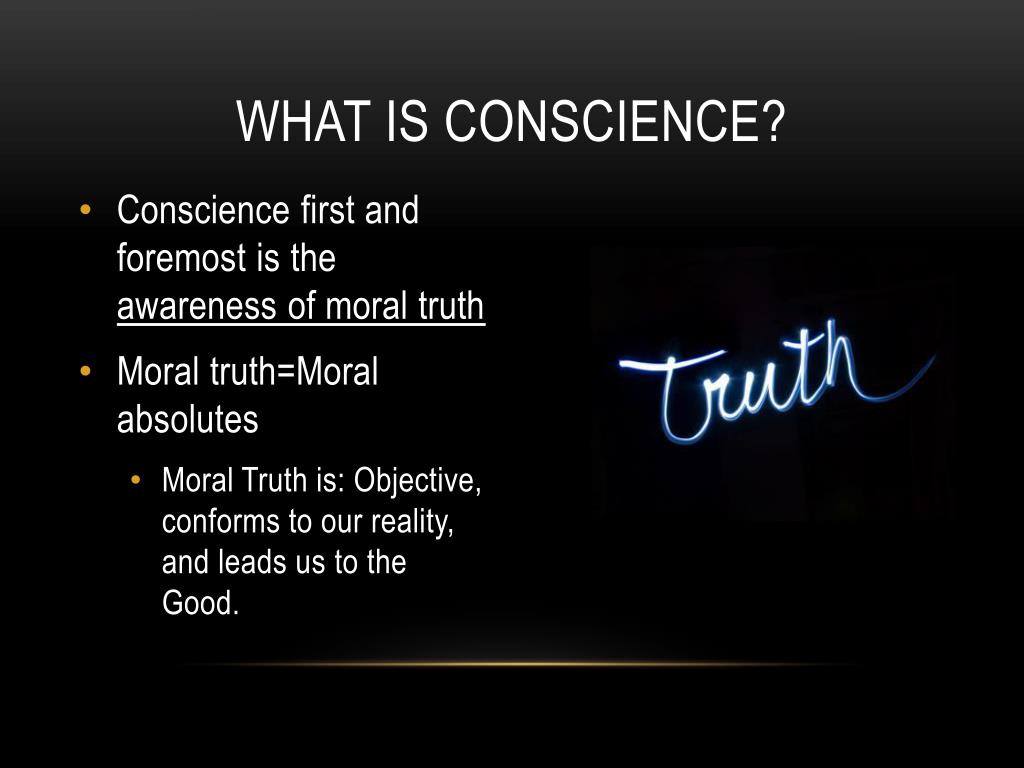
I confronted someone in high position in my workplace, and it wasn’t about what he did but about him wanting to be right. The thing is one can deceive the whole world but it’s hard to deceive your own conscience and that where guilty plays. The bible never tells us to live by our conscience, but by FAITH. I am not going to tell you I always live by faith these days, but I certainly don’t live by my conscience but by THE TRUTH that no good dwelleth in me. If giving the truth, it is not what will make you yield a sword against me then you will never get the truth from me. And as King David said, “For all his judgments were before me, and I did not put away his statutes from me.” Psalm 18: 25-29
25 With the merciful thou wilt shew thyself merciful; with an upright man thou wilt shew thyself upright.
26 With the pure thou wilt shew thyself pure; and with the froward thou wilt shew thyself froward.
27 For thou wilt save the afflicted people; but wilt bring down high looks.
28 For thou wilt light my candle: the Lord my God will enlighten my darkness.
29 For by thee I have run through a troop; and by my God have I leaped over a wall.
So even though my heart and flesh fail God is the strength of my life and portion forever. Even if I fail God did not fail. So, when I confronted the person, I realize that’s how John felt, however one should never correct a fool twice. Once is enough to hate you. Proverbs 9:8; I will not be overly righteous as I don’t want to die before my time, and I will not be overly wicked either. Ecclesiastes 7:16–17. It’s precisely because John was trying to be overly righteous, he died, sometimes turn off the truth and live by faith, God did not fail even if I do. I just simply followed King David method with King Achish.
Here is your corrected version with grammar, punctuation, and tense issues fixed. I have kept your wording and structure the same, only correcting errors:
“But the fruit of the Spirit is love, joy, peace, patience, kindness, goodness, faithfulness, gentleness, and self-control. Against such things there is no law.”
So, yesterday was Valentine’s Day, but much of the talk about Valentine’s was spoken about today in church, being the 15th of February. That the fruit of the Holy Spirit is first love — that is, as I say, the first fruit before joy. And that sometimes the things we look for in physical love often reflect the spiritual ones too. Like you will ask some men why they married their wives, and they will say, “She gives me peace.” It’s an outward manifestation of the inner one. And the query our pastors had was: most of us have been Christians for 15 years or more — when was the last time we spoke to anyone about Christ? And that love is not blind because Jesus said, “If you love Me, you will keep My commandments.” Of course, the room is always quiet at this point. He says that if you walk with some church people, you are supposed to be recognized with that church, such is the aroma and fragrance of Christ on us — which is His love.
That if we look at the Bible, Jesus did not come to earth to perform miracles; He wasn’t the first person to raise someone from the dead. Some, like Elisha, had done it and done more miracles before Jesus came. The main reason Jesus came to the earth is so that we will be saved from our sins. No man could do that except Jesus, being both God and man, and the mediator of the second covenant spoken of by the prophet Isaiah.
He went on to say that’s why Jesus came — so love moves. Jesus came down to earth (He moved) to show us the way to salvation (His mission). That is why He is our perfect witness of love (Rev. 1:5), our faithful witness. That when God tells us to love our neighbors, it’s no guarantee they will love you back. That just because we don’t eat lions doesn’t mean lions won’t eat us (a Yoruba adage). But why am I going on and on about what he describes love as?
For me, I don’t believe the church is suffering from a lack of love. For anyone to have been a Christian for over 15 years, it’s not because you have not seen the love of God. I mean, if you are in a relationship with Christ, you won’t be there if it’s not benefiting you or you aren’t gaining anything because of human nature in man. By this I mean John 6:26: “Jesus answered them and said, ‘Most assuredly, I say to you, you seek Me, not because you saw the signs, but because you ate of the loaves and were filled.’” And His provision is a reflection of His love for us. That is why He is called Jehovah Jireh — He provides His Son, gave manna, and all. So, we have experienced a measure of God’s love for us through His Son.
Now, the idea that we think our sins affect God is laughable because from Habakkuk, we know God cannot look at sin. So as Christians, His Son is a perfect sacrifice for atonement for our sins so we can have access to the Father. So, our sin no longer affects God because His Son mediates for us as Christians, but guess what? It affects other Christians. Job 35:8: “Your wickedness only affects humans like yourself, and your righteousness only other people.” So, we know that God is too pure to behold iniquity (Habakkuk 1:13). That’s why His Son came — for the Father not to see sin on us and to restore man through salvation. The problem is this:
“And because iniquity shall abound, the love of many shall wax cold. But he that shall endure unto the end, the same shall be saved.”
Iniquity will abound in the last days, causing the love of many people to grow cold. Notice God is not bothered by this because His Son atones for this, but the battle is with humans and other humans causing others, by their actions, not to believe in God. The interesting thing about this period is that Jesus describes it as Him returning as a thief in the night (1 Thessalonians 5:2, Revelation 16:15, Matthew 24:43), signifying that people would be caught off guard or unaware.
Matthew 24:37–39 still emphasizes it would be like business as usual:
“But as the days of Noah were, so shall also the coming of the Son of Man be. For as in the days that were before the flood they were eating and drinking, marrying and giving in marriage, until the day that Noah entered into the ark, And knew not until the flood came and took them all away; so, shall also the coming of the Son of Man be.”
Luke 17:34 further states how this will be subtle: “I tell you, on that night two people will be in one bed; one will be taken and the other left. Two women will be grinding grain together: one will be taken and the other left.”
Telling you it will be as a normal day — no obvious chaos or distortion. So, when analyzing the church today, the question I would ask is not whether there is love in the church, but whether that love has waxed cold already. As we scream about human love, one wonders about the condition of the human heart toward God. So, I do say Happy Valentine’s, but the first fruit is still the LOVE OF GOD, THEN LOVE FOR MAN.